


Lock down the basics and catch the right signals
We lay the foundations: consent, compliance, reliable signals. The goal is simple — don't lose the essential data that powers your campaigns.
Build a structure that lasts
With Tag Manager and server-side tracking, we consolidate your data despite browser blockers.
Connect your business reality to ad platforms
Your actual sales feed back into Google Ads. The algorithm learns what brings you real customers and focuses effort on profiles that actually book.

Why do your competitors pay less per lead than you?
That's the awkward question. You've got the same keywords, same audiences, sometimes the same offers. Yet the algorithm keeps favouring them.
It's not because they've got more budget. It's because they teach the machine better.
The invisible battle: Picture two agencies
Agency A (You?): Sends Google a "Click" or "Page view" signal. It's weak. Too vague for the algorithm.
Agency B (Your competitor): Sends a "€3,000 quote signed" signal via their CRM and server-side tracking. That's strong.
The algorithm's verdict: Google and Meta want certainty. Because Agency B gives them proof of profitability, the algorithms serve them the best prospects on a plate — often at lower cost.
The result: Until your data infrastructure catches up, you're fighting with plastic weapons against tanks.
Let's level the playing field.
Why this matters (The concept)
Data is fuel for your campaigns.
Today, Google and Meta are AI-powered machines. But these machines are hungry.
Feed them bad data (or no data), they fly blind.
Feed them rich data (real customers, margins), they become snipers.
My job: Connect your tools to create a virtuous cycle.
The step-by-step method: from compliance to performance
An infrastructure built in logical order.
You don't put the roof on before the foundations. Here's how I structure your data ecosystem, step by step.
Step 1: Compliance
Before you collect anything, you need permission. It's the law, and it's a Google requirement (Consent Mode V2).
Consent banner (the CMP)
The tool: A CMP (Consent Management Platform) like Axeptio or Sirdata.
The action: Your web agency installs or updates the CMP. No more ugly cookie banner blocking the site. We make it reassuring and GDPR-compliant.
The technical point: I activate Google Consent Mode V2. This tells Google: "This user refused cookies, but we can still model their behaviour anonymously." Without this, you lose 30% of your data from the start.
Step 2: Collection
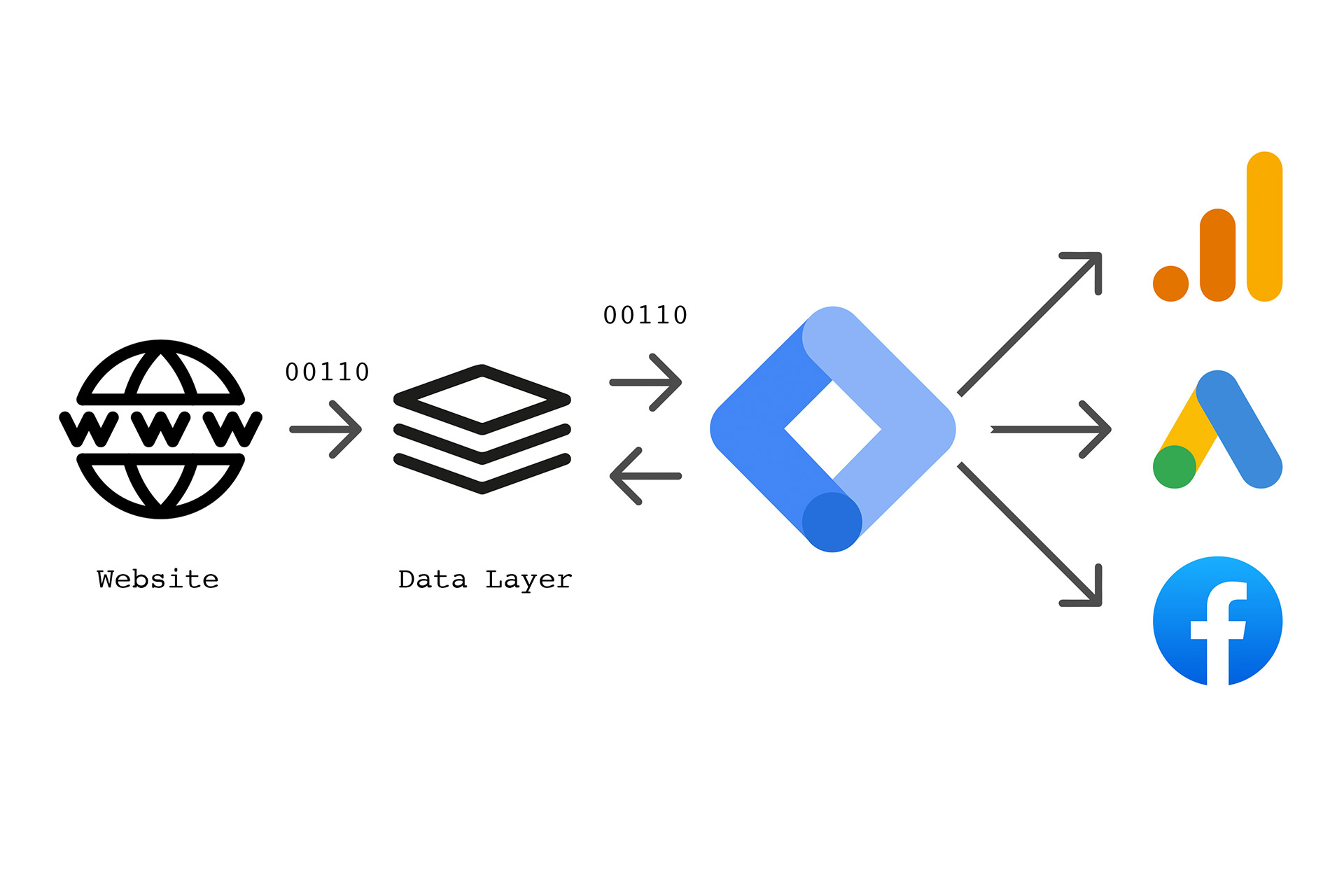
GTM handles integration of all your ad tags.
Now we've got permission, we need to capture information without losing it.
The conductor: Google Tag Manager (GTM). It's the central hub where I store all tags. This lets you add marketing tools without touching site code every time.
The armour (Server-side tracking / CAPI): Critical for travel.
The problem: Browsers (Safari on iPhone) delete cookies after 7 days. But your customers often take 30 days to decide. You lose track of Sophie before she books.
The solution: Install server-side tracking. We send data directly from your server to Facebook/Google's server (monthly cost from a technical provider required).
The result: We extend cookie lifespan. We track users through their entire long decision cycle and bypass ad blockers.
Step 3: Enrichment (The rocket fuel)
This is where you pull ahead — by connecting your business reality (CRM) to ad platforms.
The truth: A click is worthless. A form fill isn't worth much. Only signed sales count.
CRM connection: I connect your CRM (HubSpot, Salesforce only) to Google and Meta.
The feedback loop (Offline conversions): When a customer signs their quote by phone 3 weeks after clicking:
Your salesperson validates the sale in the CRM.
The info automatically flows back to Google Ads.
The algorithm gets it: "Ah! This is the profile type that buys! I'll find more like them."
Step 4: Analysis (The dashboard)
Having data is good. Understanding it at a glance is better.
The control centre: Google Analytics 4 (GA4). Its role is twofold:
- Centralise visitor behaviour to create audience segments we feed back into Google Ads.
- Attribute conversions to the right channels. Let's be clear: with GDPR, we only see about 70% of reality. My job is configuring the tool so that 70% is clean and usable to drive your profitability.
The visualisation: Looker Studio. No more unreadable Excel files. I build you a custom dashboard, updated in real-time.
What you'll see: How much I spent. What's my cost per quote?
The goal: Make strategic decisions in 30 minutes at the start of each month.
Why outsource this technical bit?
Modern tracking has become a specialty in its own right. And it's a quick way to cut acquisition costs.
A badly placed pixel = Sales counted twice.
Botched GDPR setup = Legal risk.
Bad CRM connection = Campaigns optimising for rubbish prospects.

.svg)
